

Diwali 2026: Gift the Soul of Kashmir — A Festive Journey Through Saffron, Pashmina & Kashmiri Craft
By: Kashmir Bazar | September 2026
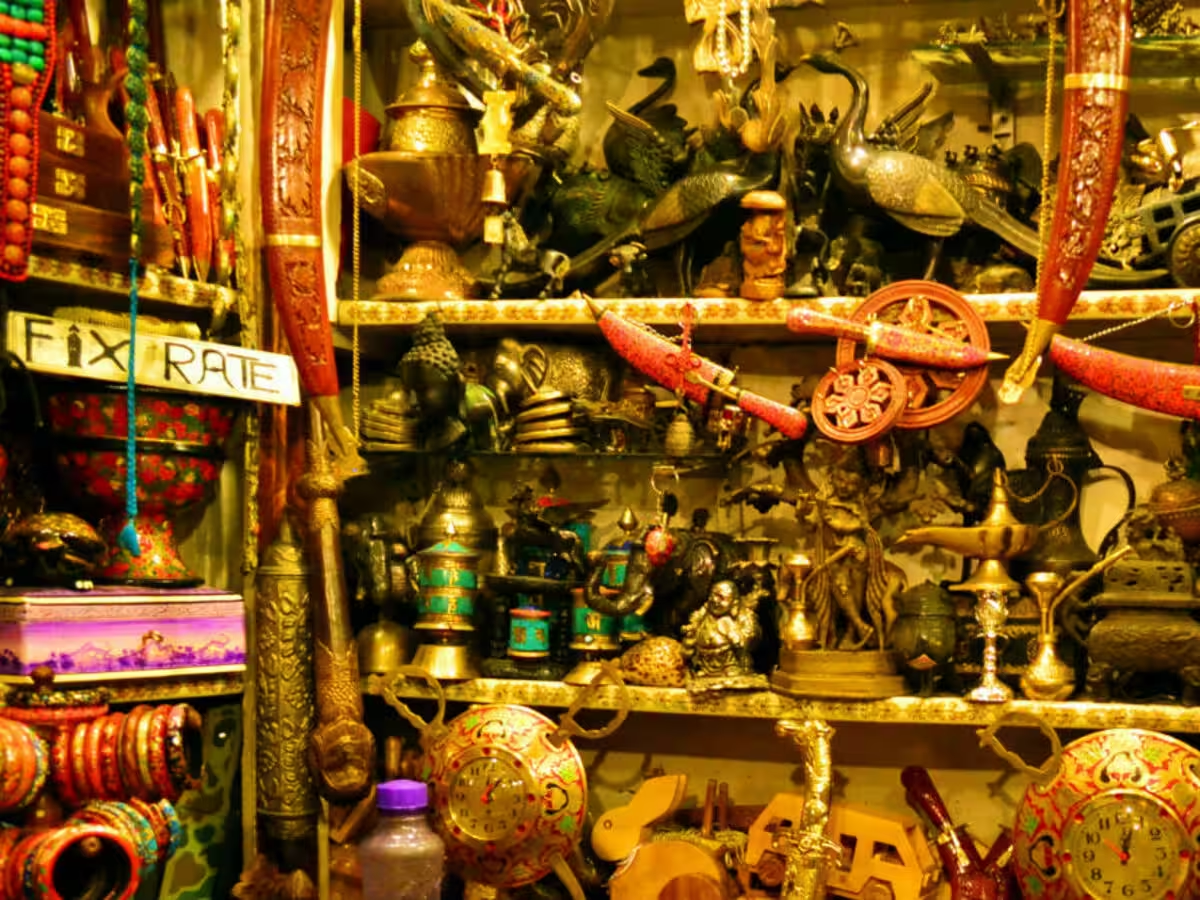
This Diwali, don’t just exchange gifts. Exchange stories — from the saffron fields of Pampore, the walnut-carving workshops of Srinagar and the timeless world of Kashmiri Pashmina to the comforting warmth of a steaming cup of Kahwa.
There are gifts that are opened, admired and eventually forgotten.
And then there are gifts that take you somewhere.
A box of fragrant saffron can transport you to the purple fields of Pampore. The intricate surface of a walnut-wood keepsake can evoke the quiet concentration of a Kashmiri craftsman at work. A Pashmina stole carries the softness of mountain winters. Even a simple Kahwa gift set can conjure an image of a warm room, steaming cups and conversations stretching into the evening.
That is the magic of Kashmiri gifting.
As India prepares for Diwali on November 8, 2026, festive gifting is once again moving into high gear. But alongside the familiar chocolates, sweets and corporate hampers, there is growing room for something more personal — products with a sense of place, craftsmanship and cultural identity.
For Diwali 2026, Kashmir Store is bringing that idea to the forefront with a collection built around some of Kashmir’s most recognisable products — saffron, Pashmina, walnut wood crafts, dry fruits, Kahwa and other regional specialities.
The proposition is simple:
Don’t gift another object. Gift a piece of Kashmir.
When a Diwali Gift Becomes a Journey
Imagine opening a festive box.
There is no generic assortment staring back at you.
Instead, there is the deep aroma of saffron, a beautifully finished wooden box, premium Kashmiri dry fruits and a packet of Kahwa waiting to be brewed.
Suddenly, the gift has a personality.
It has geography.
It has history.
It has people behind it.
That distinction is becoming increasingly important in premium gifting. The appeal of regional products lies not only in what they are, but in where they come from and the traditions that surround them.
Kashmir has an unusually rich vocabulary of such products.
Its saffron is associated with the fields around Pampore. Its Pashmina tradition has been refined over generations. Walnut wood carving has developed into one of the Valley’s distinctive handicrafts. Kahwa remains closely associated with Kashmiri hospitality.
For a festive gift, that gives businesses and families something conventional gift boxes often lack:
a story worth telling.
Kashmiri Saffron: A Little Box from the Valley’s Purple Fields
Few ingredients command the mystique of saffron.
In Kashmir, the story begins in the fields.
The saffron-growing belt around Pampore is one of the most recognisable agricultural landscapes associated with the spice. Kashmir Saffron received India’s Geographical Indication registration in 2020, giving the regional product formal GI recognition.
That geographical identity adds meaning to a premium festive gift.
But it also comes with an important responsibility for shoppers: not every product sold as “Kashmiri saffron” should automatically be assumed to be genuine Kashmir Saffron.
For buyers, provenance matters.
A reputable seller should be able to provide clear information about origin, packaging and, where applicable, authentication or certification.
Kashmir Store’s saffron offerings provide an opportunity to make this extraordinary spice the centrepiece of a festive hamper.
And saffron works beautifully as a gift because it is both luxurious and practical.
It can find its way into festive desserts, rice dishes, milk, beverages and traditional recipes long after Diwali decorations have been packed away.
That makes it more than a luxury ingredient.
It becomes a taste of Kashmir that stays in the recipient’s kitchen.
Pashmina: The Softest Story Kashmir Can Tell
If saffron captures Kashmir’s landscape, Pashmina captures its craftsmanship.
Few textiles have acquired the cultural and luxury associations of Kashmiri Pashmina.
The craft is officially recognised under India’s Geographical Indication system, with Kashmir Pashmina registered as a GI product.
But Pashmina is also a category where informed buying matters.
The popularity of the word has created plenty of confusion in the marketplace. A label saying “Pashmina” by itself is not enough to establish the provenance or authenticity of a high-value product.
The Export Promotion Council for Handicrafts, in association with the Wildlife Institute of India, operates a Pashmina Certification Centre intended to support testing and traceability of Pashmina products.
For anyone buying an expensive Pashmina as a Diwali gift, asking about certification and provenance is therefore part of smart shopping.
For corporate gifting, meanwhile, Pashmina has a natural advantage.
A beautifully presented stole can become a long-term keepsake rather than another item destined for a cupboard.
For a senior executive, a valued client, a parent or someone celebrating a significant personal milestone, it carries the feeling of a gift chosen rather than simply purchased.
Walnut Wood: Where the Artisan Leaves His Signature
There is something wonderfully tactile about Kashmiri walnut wood.
Run your fingers across a carved surface and the difference between handmade craftsmanship and factory production becomes immediately apparent.
Kashmir’s walnut wood carving is a recognised GI craft, with traditional artisans producing everything from decorative panels and boxes to furniture and smaller contemporary objects. Government handicraft documentation identifies Kashmir Walnut Wood Carving among the region’s recognised traditional crafts.
For Diwali, walnut wood has another advantage.
It naturally fits the festival’s relationship with the home.
A beautifully carved box can hold jewellery. A decorative tray can become part of a festive setting. A desk accessory can travel into an office. A small keepsake can remain on a shelf long after the diyas have been extinguished.
For companies, handcrafted walnut products also create interesting possibilities for premium corporate gifting.
A tasteful company mark or personalised presentation can transform the item into something that connects the brand with craftsmanship rather than simply placing a logo on another promotional product.
Any branding, minimum-order quantity, pricing and production timeline, however, should be confirmed directly with Kashmir Store before placing a corporate order.
Kahwa: The Warmest Part of a Kashmiri Gift
Some gifts are meant to be displayed.
Others are meant to be experienced.
Kahwa belongs firmly in the second category.
A traditional Kashmiri drink, Kahwa is closely associated with hospitality in the Valley. Saffron, cardamom and other spices can give it its characteristic fragrance, turning an ordinary tea break into something warmer and more ceremonial.
Put Kahwa inside a festive hamper and the gift suddenly becomes interactive.
Open the box.
Boil the water.
Brew the tea.
Pour.
Share.
That simple ritual is precisely what makes food and beverage gifts so effective during Diwali.
They create occasions for people to sit together.
A Kashmiri Kahwa gift set can therefore complement saffron, dry fruits or honey in a hamper, creating an experience that feels distinctly different from a standard assortment of packaged sweets.
Dry Fruits from Kashmir: A Classic That Never Goes Out of Style
There is a reason dry fruits continue to occupy such an important place in Indian festive gifting.
They are familiar, useful and naturally suited to sharing.
Kashmiri almonds, walnuts and dried fruits add a regional character to that familiar tradition.
Kashmir Store’s current catalogue includes regional food products and dry fruits alongside handicrafts and apparel, giving buyers the option of building gifts around several aspects of Kashmiri culture rather than relying on a single product category.
For large corporate programmes, dry fruits can form the practical foundation of a hamper.
For premium gifting, they can become one element in a larger story.
Pair them with saffron.
Add Kahwa.
Introduce walnut wood.
And suddenly, a familiar festive ingredient becomes part of a distinctly Kashmiri experience.
The Art of Building a Kashmiri Diwali Hamper
The secret to a memorable hamper is not necessarily adding more products.
It is creating harmony between them.
The Everyday Festive Hamper
A practical combination might include:
Kahwa + Kashmiri dry fruits + saffron
It is compact, useful and suitable for employee gifting, friends and extended family.
The Artisan Hamper
For someone who appreciates craftsmanship:
Saffron + Kahwa + walnut-wood keepsake
Here, the gift combines taste with something designed to last.
The Premium Corporate Hamper
For important clients or senior leadership:
Pashmina + saffron + premium dry fruits + handcrafted walnut presentation box
This is less about quantity and more about presentation, provenance and perceived exclusivity.
The Family Diwali Hamper
For parents or close relatives:
Saffron + Kahwa + dry fruits + handcrafted décor
It brings together food, warmth and the visual character of Kashmir.
The strongest combinations are those that feel curated rather than crowded.
Corporate Diwali Gifting Gets a Kashmiri Makeover
For businesses, Diwali gifting is more than an annual formality.
It is a moment when a company communicates appreciation.
Employees receive recognition. Clients receive thanks. Partners receive goodwill.
That is why the choice of gift matters.
A mass-produced item with a logo may perform its basic function. But a regional, artisan-linked gift can create a stronger emotional connection.
Consider the difference.
One box says:
“Here is your annual Diwali gift.”
The other says:
“Here is something from Kashmir.”
The second immediately creates curiosity.
Where does the saffron come from?
Who made the box?
What makes Pashmina different?
How is Kahwa prepared?
A corporate gift has suddenly become a conversation starter.
For companies with large employee bases, Kashmir Store can be approached for bulk gifting requirements and customised combinations. Current ordering requirements, pricing, branding possibilities, quantities and delivery schedules should be confirmed directly with the store, particularly for large festive programmes.
From Srinagar to Your Office: The Appeal of Direct Regional Gifting
Kashmir Store describes itself as a marketplace focused on Kashmiri products and says its model connects customers with artisans and designers from the region. Its current catalogue covers multiple categories, including food, crafts and clothing.
That model has an important advantage for festive shoppers.
Instead of searching separately for saffron, Pashmina, walnut craft and regional foods, customers can explore multiple categories through one marketplace.
For corporate procurement teams, that can simplify the discovery stage.
But the same rules that apply to any large festive purchase still matter:
check the product specifications, ask about certification where relevant, confirm quantities, obtain a quotation and agree on delivery schedules before payment.
That is particularly important as Diwali approaches and demand for popular products increases.
Why “Made in Kashmir” Means More Than a Label
The phrase “Made in Kashmir” can sound simple.
The reality behind it is not.
Behind a bottle of saffron, there may be farmers working with a crop whose cultivation depends on precise seasonal conditions.
Behind a Pashmina product, there can be multiple stages involving fibre, spinning, weaving, finishing and skilled craftsmanship.
Behind a carved walnut box is an artisan whose expertise may have been learned over years rather than months.
This is what gives regional gifting its emotional weight.
The product becomes a connection between the person who makes it and the person who receives it.
India’s GI framework plays an important role in this larger story by formally recognising products whose qualities, reputation or characteristics are linked to a particular geographical origin.
Kashmir’s recognised GI products and crafts therefore offer buyers a useful starting point for understanding what makes the region’s products distinctive.
But GI recognition should be understood properly: it is not a blanket guarantee attached to every product using a regional name.
That distinction makes transparent sourcing even more valuable.
Diwali 2026: A Festival of Light, a Season of Stories
There is a poetic connection between Diwali and Kashmir’s traditional crafts.
Diwali celebrates light.
Kashmir has spent generations transforming natural materials, agricultural produce and textile traditions into objects of beauty.
A walnut box becomes part of a home.
A Pashmina becomes part of someone’s winter.
Saffron becomes part of a festive recipe.
Kahwa becomes part of a conversation.
A gift therefore does not end when the wrapping paper is removed.
It enters someone’s life.
And perhaps that is what today’s best festive gifting is really about.
Not excess.
Not size.
Not the biggest box on the table.
Meaning.
The Kashmir Store Diwali Collection: What Makes It Different?
The current Kashmir Store marketplace brings together several product categories associated with Kashmir, including regional food products, dry fruits, handicrafts, clothing and other speciality products.
For Diwali shoppers, that opens up several possibilities.
You can keep it simple with saffron.
Make it indulgent with dry fruits and Kahwa.
Make it artisanal with walnut wood.
Make it luxurious with Pashmina.
Or combine several of these elements into a single story-led hamper.
The choice ultimately depends on the recipient and the occasion.
And that is exactly why Kashmiri gifting works so well.
There is no single definition of a Kashmiri gift.
It can be a small packet of saffron.
It can be an elaborate corporate hamper.
It can be a hand-carved box.
It can be a warm cup of Kahwa shared between family members.
Or it can be a Pashmina wrapped around someone’s shoulders on the first cold evening of winter.
Smart Buying Matters: What to Check Before Ordering
The growing popularity of regional products also means buyers should become more discerning.
Before purchasing premium Kashmiri gifts, particularly for corporate distribution, check:
1. Product origin
Ask where the product was produced and sourced.
2. GI status
If a seller describes an item as GI-registered, verify whether the specific product and category actually have GI recognition.
3. Pashmina certification
For expensive Pashmina purchases, ask what authentication or certification documentation is available.
4. Corporate quantities
Bulk orders can involve different pricing and packaging arrangements from individual retail purchases.
5. Delivery timelines
Diwali is a high-demand period. Large orders should be planned well before the festival.
6. Customisation
If you need company branding, personalised cards or customised packaging, confirm production timelines before finalising the order.
These checks do not diminish the romance of Kashmiri gifting.
They strengthen it.
Because a beautiful gift is even better when its story is genuine.
Why Kashmir Could Be One of Diwali 2026’s Most Interesting Gifting Stories
The Indian festive market has never lacked choice.
There are sweets from Delhi, chocolates from Mumbai, handicrafts from Rajasthan, teas from Assam, spices from Kerala and countless regional specialties from across the country.
Kashmir brings something different to that landscape.
It combines natural luxury with craftsmanship.
Food with heritage.
Textiles with history.
Craft with geography.
That combination gives Kashmiri gifts an emotional advantage.
They are not simply products from a region.
They are introductions to a place.
And for Kashmir Store, that is where the opportunity lies.
The brand can do more than sell saffron, Pashmina, dry fruits or handicrafts. It can package the idea of Kashmir itself — carefully, responsibly and in a way that allows the recipient to discover something beyond the object inside the box.
This Diwali, Gift Something That Has a Story
Perhaps the most memorable Diwali gifts are not the ones that make the biggest impression when the box is opened.
They are the ones that continue making an impression afterwards.
The saffron used months later.
The Kahwa brewed on a winter evening.
The walnut box sitting on a desk.
The Pashmina brought out when the temperature drops.
The memory of who gave it — and why.
That is the quiet strength of authentic Kashmiri gifts.
They carry a little of the Valley with them.
For Diwali 2026, Kashmir Store invites families, friends, businesses and corporate buyers to explore that tradition through a curated selection of Kashmiri products.
Because this year, the most meaningful gift may not be something made for a festival.
It may be something made by people, shaped by a place and carried forward by tradition.
This Diwali, don’t just give a gift. Give Kashmir.
Explore Kashmir Store
Discover the latest collection of Kashmiri food products, handicrafts, apparel and regional specialities through Kashmir Store.
For corporate and bulk requirements, contact the store directly to confirm current product availability, pricing, customisation, certification and delivery timelines.
Kashmir Store
Wani Manzil, Lambert Lane, Residency Road, Srinagar, Jammu & Kashmir
Phone: +91 94697 24 365
Email: Sales@KashmirStore.in
Diwali 2026: November 8
Gift Kashmir. Share a story. Make this Diwali memorable.