

Fake Saffron Test: 8 Clues to Spot Real Kashmiri Saffron
By: Kashmir Bazar | October 2026
Saffron is the most carefully faked spice on the shelf. Here is who the usual suspects are, which clues give them away, and what no home test can prove.
Imagine a shopper in a spice market, holding a small box of deep red threads. The seller says they’re Kashmiri. The price looks fair, or maybe a little too fair. The shopper has about thirty seconds to decide.
That moment is where saffron fraud works. Buyers can’t taste origin or read a lab report on the spot, and the product is sold by the gram. This guide gives you a method: know the usual tricks, run the right checks, and ask for the right paperwork.
Why saffron attracts fakers
Saffron is expensive because it is hard to make. It takes up to 150,000 blooms to produce one kilogram, and no machine can harvest it, so every flower is picked by hand. Kashmiri saffron carries extra value: it received a Geographical Indication tag in 2020, which ties the name to the region.
High value, tiny quantities and hard-to-judge quality are what make a product easy to fake. Concern about adulteration is not new, either. A medical journal note from 1845 discusses adulteration of saffron with crocus leaves as the most frequent kind. The tricks have changed, but the problem hasn’t.
There may also be a supply angle this year. Farmers say last season’s output fell by nearly 95 percent, and a tight market is the kind of situation where buyers should be more careful, not less. New-crop saffron usually reaches shops from late November into December, once it has been separated and dried.
Also Read | Kashmir Bazar Festive Guide 2026: Christmas Gifts, Crewel Décor, Pashmina & New Year Hampers
Meet the usual suspects
Fake or adulterated saffron comes in several forms. Knowing them helps you pick the right test.
| Suspect | How it works | What gives it away |
|---|---|---|
| Dyed maize cob or corn silk | Strands are coloured to look like threads | FSSAI warns saffron can be adulterated with dried maize cob. A dyed corn-silk strand leaves no stain on paper and feels papery. |
| Safflower or turmeric | Cheaper plant material added to bulk it up | Researchers study safflower and turmeric as common adulterants, which lab methods can detect. |
| Powder mixes | Paprika, salt, synthetic dyes or turmeric in powder | Powdered saffron is more vulnerable to adulteration than whole threads. |
| Dyed petals | Shredded or coloured petals | Marigold or turmeric-type fakes colour water instantly and evenly. |
| “Stretched” real saffron | Genuine threads mixed with old threads or weighted | Real saffron can be cut with spent threads or weighted with oil, honey, glycerin or water mist to raise the sale weight. |
| Grade swap | A lower grade sold as a higher one | Lacha is priced noticeably lower than Mongra, so there is a reason to mislabel. |
Note that the last two involve real saffron. A product can be genuine and still be misrepresented, which is why paperwork matters as much as tests.
Know the real thing: Mongra, Lacha and Zarda
Before you can spot a fake, know what genuine Kashmiri saffron looks like. Traders sort it into grades:
- Mongra: Only the dark red tips, with no yellow or white parts. It is the premium grade.
- Lacha: The red stigma with the yellow style still attached. It is genuine, but gives less colour per gram.
- Zarda: The cheapest grade, made of lighter-coloured tips.
So a bit of yellow at one end of a thread is not a red flag by itself. It may simply mean Lacha. The problem arises only if you’ve been sold Lacha as Mongra.
The field kit: eight clues, in order
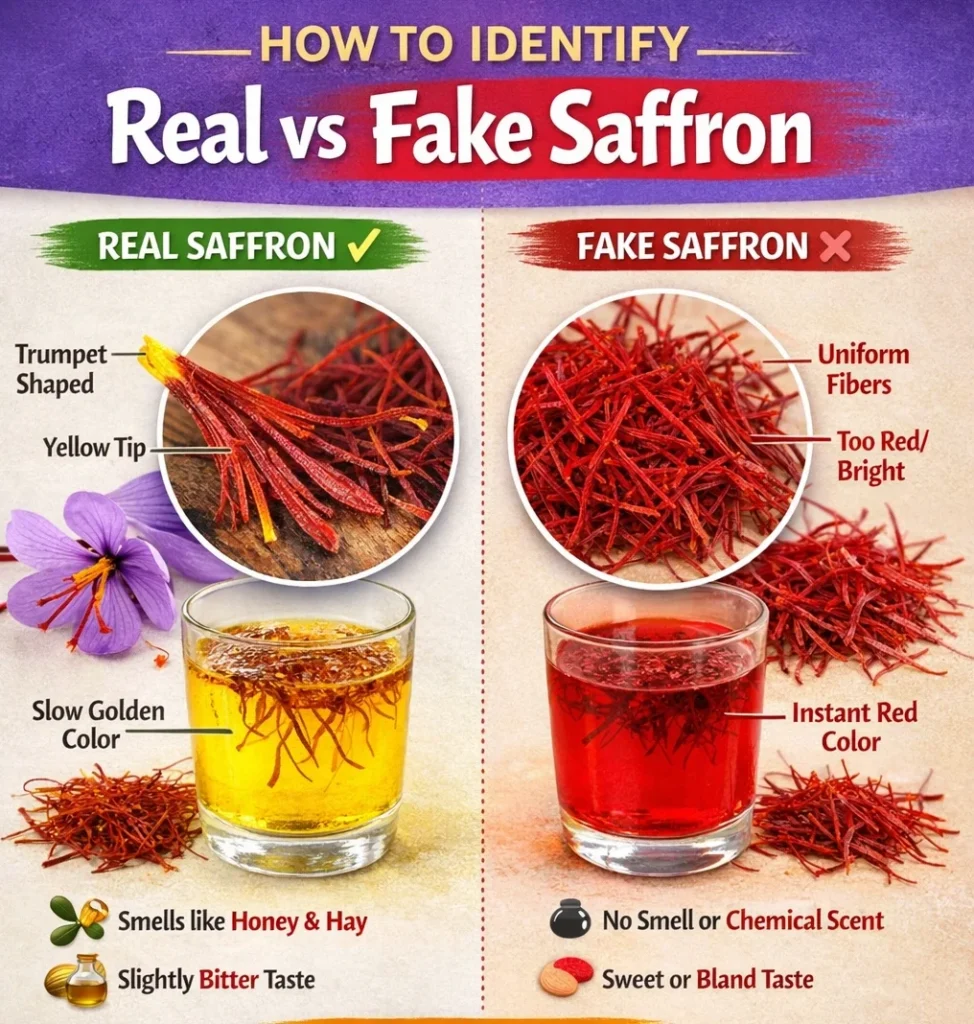
Clue 1: The thread. Real threads flare into a trumpet at one end and are irregular in shape, while fakes tend to be uniform, straight strips. Be wary of threads that are unnaturally bright or perfectly even.
Clue 2: The smell. Genuine saffron smells sweet and faintly medicinal, like hay with honey behind it. An aggressively sweet or artificial-fruit aroma, or none at all, points away from real saffron.
Clue 3: The taste. Once you have decided to buy, or at home before use, taste a single thread. Real saffron tastes bitter, never sweet.
Clue 4: The water test. This is the main test. Drop a few threads into clear water and wait without stirring.
- Real: golden-yellow colour released slowly over 10 to 15 minutes, with threads that stay crimson.
- Fake: instant red colour, with threads that turn pale or white within minutes.
Water temperature varies by source. FSSAI’s version uses hot water at 70 to 80 degrees Celsius, while others use cold or room-temperature water. The pattern is what matters, but remember: cut or damaged genuine threads can release colour quickly, so one result isn’t final.
Clue 5: The rub test. Rub a moist thread between your fingers. Real saffron leaves a golden-yellow stain on the skin. A red stain suggests dye.
Clue 6: The paper test. Real saffron leaves a soft, feathered golden-yellow mark, while fake saffron leaves a sharp red or orange ring.
Clue 7: The baking-soda test. Stir a pinch into water and add a few threads. Real saffron turns the solution yellow, while dyed saffron turns it pinkish-red or leaves it unchanged.
Clue 8: The form. Whole threads can be inspected. Capsules and powders are the easiest place to hide adulteration, because you can’t run a water test on a sealed powder. If you can, buy threads.
Also Read | Bringing Kashmir Home: 12 Kashmiri Products That Can Transform Your Everyday Space
What the clues can’t tell you
Home tests can expose obvious fakes. They can’t confirm purity, grade or origin. Even experts note that results depend on thread damage, water amount and soaking time.
Origin isn’t the same as quality either. Saffron from different regions can be high quality when properly graded under ISO 3632, regardless of origin. What makes a “Kashmiri” claim believable is documentation, not appearance.
Reading the paperwork
Here is the paper trail a serious seller should be able to show:
- GI tag. Ask whether the product is GI-certified, and how the seller can show it.
- ISO 3632 test report. ISO guidelines are the international standard for certifying saffron quality, testing aroma, flavour and colour strength. Ask for the actual lab report, not just a badge.
- Origin and harvest details. Reputable sellers provide origin documentation and transparent harvesting dates.
- Grade. The label should say Mongra, Lacha or another grade, and the price should match.
A seller who is happy to show these is giving you real information. A seller who changes the subject is giving you information too.
Where and when to buy
- From people who can answer questions. Growers and established sellers should be able to say where the crop was grown, which grade it is and when it was harvested.
- In season. The harvest runs from late October into November, and the dried new crop reaches markets weeks later. Ask about the harvest year.
- At the source, if you can. Pampore is a short drive from Srinagar, and some growers sell directly. Visit during the bloom if you want to see the process, and ask permission before entering fields.
After you buy: storage and use
- Store it in an airtight container in a cool, dry place.
- Use it sparingly. A few threads are enough for a dish or a cup of kahwa.
- Steep first. Soak the threads in a little warm water or milk before adding them to food, which brings out the colour and aroma.
Your ten-second checklist
- Whole threads, not powder
- Red threads with a trumpet end, irregular, not uniform
- Hay-and-honey aroma, not sweet or perfumed
- Bitter taste, never sweet
- Slow golden colour in water, threads stay red
- Yellow stain on a wet finger, not red
- GI tag and a real ISO 3632 report
- Harvest date and origin details
- A price that makes sense
- A seller who answers questions
Also Read | Beyond Sweets: Why Authentic Kashmiri Gifts Could Define Diwali 2026
Frequently asked questions
How do I know if saffron is fake?
Check the thread shape and colour, smell it, and run the water test. A red colour that appears instantly, pale threads, or a sweet smell are warning signs.
Is the water test enough?
No. Use it with the rub, paper and smell checks, and ask for paperwork. Cut genuine threads can also release colour fast.
What are the most common fake saffron ingredients?
Dyed corn silk or maize cob, safflower, turmeric, paprika, and coloured petals. Real saffron can also be bulked up with oil, honey or glycerin.
Is powdered saffron always fake?
No, but it is more vulnerable to adulteration and harder to inspect, so whole threads are the safer buy.
Does yellow on the thread mean it’s fake?
Not necessarily. Lacha keeps the yellow style and is still genuine, though lower grade than Mongra.
What does the GI tag actually prove?
It links the name “Kashmiri saffron” to the region. Ask the seller how they can show it, and back it up with a test report.
What is ISO 3632?
The international standard for grading saffron, covering aroma, flavour and colour strength.
Is Kashmiri saffron always better than other saffron?
Not automatically. Quality depends on grade and testing as much as origin.
When is new-crop Kashmiri saffron sold?
Usually from late November into December, after drying.
How should I store saffron?
In an airtight container, in a cool and dry place.
The bottom line
Real saffron gives itself away slowly: golden water, red threads, a bitter taste and a trumpet tip. Fakes tend to give themselves away quickly. When in doubt, ask for the paperwork, and walk away from anything you can’t verify.

