
Kashmir Saffron Harvest 2026: A Field Guide to Pampore’s Short, Precious Season
By: Kashmir Bazar | October 2026
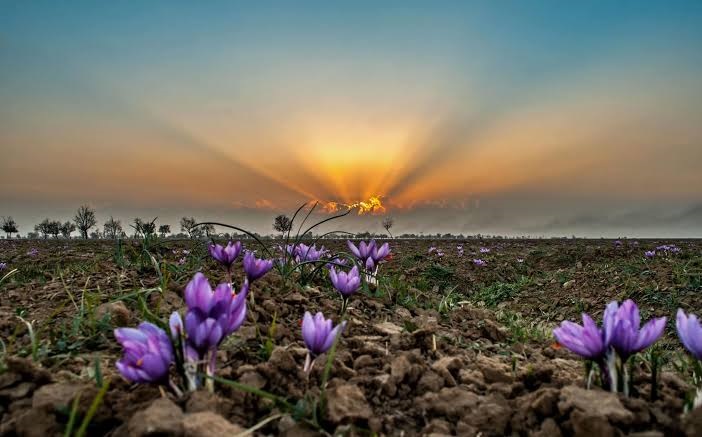
Flowers are opening on Pampore’s karewa plateaus and picking is expected to start this week. Here is how a harvest day runs, how saffron is made and graded, where it comes from, and what buyers should know.
At a glance
- Where: Pampore, Pulwama district, a short drive south of Srinagar
- When: Late October to early November, sometimes into mid-November
- How long: About two to three weeks of visible bloom
- How it’s picked: Entirely by hand, in the morning
- Output: Up to 150,000 flowers for one kilogram of saffron
- Status in 2026: Flowers have started emerging and harvesting is expected to begin this week, according to Greater Kashmir on 23 October.
The Kashmir saffron harvest is a short event with a long wait behind it. Growers spend most of the year on the soil, the corms and the weather, and then get a few weeks to gather the crop. Whether that crop is good or poor depends largely on rain and temperature in these same weeks.
Looking for Kashmiri saffron and regional specialities?
A harvest day, hour by hour
No two farms run identically, but the rhythm of a harvest day is broadly the same.
Early morning: picking. Families go to the fields early, while the air is cool, and pick the open flowers into baskets. Flowers are collected soon after they open, because they fade fast. There is no mechanised way to harvest saffron, so every flower passes through a human hand.
Late morning: carrying and sorting. The baskets are taken home, where the flowers are heaped up and sorted. Each flower holds three red stigmas, which are the saffron, surrounded by purple petals and other parts that are discarded.
Midday and afternoon: separating the stigmas. This is slow, close work. Family members sit together and pull the stigmas out by hand. It is the step where the numbers become real: it takes up to 150,000 blooms to produce one kilogram of saffron.
Evening and the days after: drying. The raw stigmas have to be dried to remove moisture before they are safe for retail. After drying, the saffron is graded, packed and sold. That’s why the new crop usually appears in shops from late November into December, not in the same week as the bloom.
Saffron by grade: Mongra, Lacha and Zarda
Not all Kashmiri saffron is the same product. Traders commonly sort it into grades based on how much of the thread is red stigma:
- Mongra: Only the dark red tips of the stigma, with no yellow or white parts. It is the premium grade and the one most associated with Kashmir.
- Lacha (Lachha): A slightly lower grade, with the red stigma still attached to the yellow style. It is still real Kashmiri saffron but gives less colour per gram.
- Zarda: The cheapest grade, made of the lighter-coloured tips of the stigma.
Saffron quality is also measured in laboratories under an international standard, ISO 3632, which tests colour strength and aroma compounds. Sellers’ published thresholds vary, so ask for the actual test report rather than relying on a label.
Shop Kashmiri saffron and gift ideas at Kashmir Bazar
Pampore: why this one town matters
Pampore is a town in Pulwama district known as the saffron town of Kashmir. Government estimates put close to 90% of Kashmir’s saffron cultivation in and around Pampore.
The crop has formal protection and recognition:
- GI tag. Kashmiri saffron received a Geographical Indication tag in 2020, applied for by the J&K Directorate of Agriculture with help from SKUAST-Kashmir and the saffron research station at Dussu. A GI tag legally ties a product’s name to its region.
- FAO heritage listing. The FAO includes the Saffron Heritage of Kashmir among India’s Globally Important Agricultural Heritage Systems (GIAHS).
- Export presence. APEDA has documented GI-tagged consignments to Saudi Arabia and the UAE.
In Kashmiri, saffron is called kong posh.
Saffron’s story in Kashmir: five moments
The origins are debated, and the older accounts are legend rather than documented history:
- The Buddhist account (5th century BC). One legend says a Buddhist missionary named Madhyantika sowed the first saffron crop on arriving in Kashmir.
- The Persian route. Another account says Persian rulers spread saffron across their empire to stock new gardens, and it reached Kashmir this way.
- The Sufi gift (11th or 12th century). According to Kashmiri tradition, two travelling Sufi ascetics, Khwaja Masood Wali and Hazrat Sheikh Shariffudin, gave a local chieftain a saffron bulb after he helped them through an illness. A golden-domed shrine to them stands in Pampore, and prayers are offered to the two saints during the harvest.
- The Mission era (2010-11). The Rs 400-crore National Saffron Mission was launched to revive the crop, mainly through irrigation.
- Recognition (2020). The GI tag arrived, and the crop’s heritage status has since drawn wider attention.
The season under strain
This harvest opens after a very poor one. Farmers say output fell by nearly 95 percent last season, which they blame on adverse weather and the continued conversion of saffron land to other uses. National Geographic called it one of the worst harvests on record. This year, recent rainfall has eased some of the worry, though much depends on the weather in the coming weeks.
By the numbers: Saffron area in Pampore fell from 5,707 hectares in 1996 to 3,500 hectares in 2021, a drop of nearly 40%.
What growers say is behind it:
- Weather. Irregular rainfall and long dry spells add uncertainty.
- Irrigation. A grower said that after years of hearing about the National Mission on Saffron, there are no functional irrigation facilities on the ground.
- Land change. Saffron land is being converted to housing and other crops.
- Crop management. A SKUAST-K scientist pointed to the siphoning of corms and poor land management.
- Pollution. Some reports also cite cement-factory pollution near Pampore.
Support Kashmiri producers by choosing regional products at Kashmir Bazar
Myth versus fact
Myth: Saffron is a spice that grows anywhere in Kashmir.
Fact: It is concentrated on the Pampore karewas, which hold most of the valley’s saffron land.
Myth: The brightest, reddest saffron is always the best.
Fact: Artificial colour can make fake saffron look vivid. Look for the proper grade and a test report, not just appearance.
Myth: Fresh saffron is in shops the week of the harvest.
Fact: It has to be separated and dried first, so it usually arrives weeks later.
Myth: Any cheap packet labelled “Kashmiri” is genuine.
Fact: A GI tag exists precisely because mislabelling is a known problem. Be sceptical of unusually low prices.
Visiting during the harvest
- Timing. The most reliable window is late October to early November. Check local reports first, since the start date shifts with the weather.
- Time of day. Go early, when picking is under way.
- Manners. These are working family farms. Ask before entering, keep to the paths, don’t pick flowers, and don’t stand in the rows.
- Combine it. Pampore fits easily into a half-day out of Srinagar. Our [Kashmir Travels guide to Pampore and the saffron season – insert link] covers routes, timing and nearby stops.
In the kitchen
Saffron is used in small amounts, so a little goes a long way. In Kashmir it is commonly added to kahwa, rice dishes and festive sweets. A few practical points:
- Steep threads in a little warm water or milk first, then add the liquid to the dish.
- Use sparingly. Too much turns bitter.
- Store it in an airtight container in a cool, dry place.
Add Kashmiri saffron to your kitchen. Order from Kashmir Bazar
Buyer’s checklist
- Ask where the saffron was grown and which grade it is.
- Look for a GI-tagged or certified product, and ask for a lab test report.
- Check the threads. Mostly red, without yellow or white filler, and not damp.
- Smell it. A chemical smell is a warning sign.
- Test a thread in warm water or milk. Real saffron releases colour gradually, while dyed fakes bleed colour quickly.
- Be wary of prices far below the market.
Frequently asked questions
When is the Kashmir saffron harvest?
Late October to early November, sometimes into mid-November. In 2026, picking was expected to begin in the week of 23 October.
How long does the bloom last?
About two to three weeks, depending on temperature and rainfall.
Where is saffron grown in Kashmir?
Mostly around Pampore in Pulwama district, which has close to 90% of the valley’s saffron land by government estimates.
Why is saffron so expensive?
Every flower is picked and processed by hand, the bloom is short, and up to 150,000 flowers make a kilogram.
What is Mongra saffron?
The premium grade, made only of the red tips of the stigma.
What is the difference between Mongra and Lacha?
Lacha keeps the yellow style attached to the red stigma, so it gives less colour per gram.
What does the GI tag mean?
It is a legal certification, granted in 2020, linking the name “Kashmiri saffron” to saffron grown in the region.
Can I pick saffron myself?
Only if a grower invites you. Most fields are private, so ask first.
Why has production dropped?
Growers cite weather, weak irrigation, land conversion and crop management issues. Farmers say last season’s output fell by about 95%.
When does the new crop reach the market?
Usually from late November into December, after drying.
How should I store saffron?
In an airtight container, in a cool and dry place.
Where can I buy Kashmiri saffron online?
You can explore Kashmiri saffron and regional specialities at Kashmir Bazar
How Kashmir’s Saffron Gets From Purple Flower to Tiny Jar
It takes up to 150,000 flowers to make one kilogram of saffron. The Kashmir saffron harvest is starting in Pampore, and every one of those flowers is handled by hand.
Step 1: Picking. Families pick the open flowers in the early morning, before they fade. Picking is expected to begin this week.
Step 2: Separating. Each flower holds just three red stigmas, which are pulled out by hand.
Step 3: Drying. The stigmas are dried before sale, which is why new-crop saffron reaches shops weeks later.
Step 4: Grading. Mongra is the premium grade, made only of the red tips. Lacha includes the yellow style and gives less colour.
The worry. Farmers say last year’s output dropped by about 95%. Official data show Pampore’s saffron area down nearly 40% since 1996.
Explore Kashmiri saffron at Kashmir Bazar