
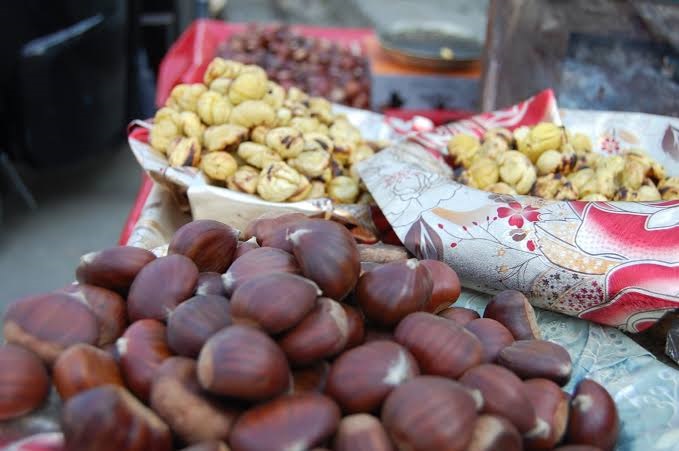

Fresh Kashmir Chestnuts Are Back — Here’s Why Autumn Waits for Them
By: Kashmir Bazar | October 2026
Srinagar: Autumn in Kashmir does not arrive with a single announcement.
It arrives quietly.
The Chinar leaves begin changing colour. Mornings acquire a gentle chill. Apple orchards grow quieter after the harvest. Markets begin filling with the flavours and produce that belong almost exclusively to this time of year.
And then there is the unmistakable sight of fresh chestnuts.
Brown, glossy, earthy and slightly rugged on the outside, Kashmir’s sweet chestnuts are among those seasonal foods that can easily be overlooked by visitors — but rarely by people who know the Valley’s autumn table.
For a few weeks, they become part of the rhythm of Kashmir: bought fresh, roasted at home, shared around family gatherings and enjoyed while the season slowly moves towards winter.
This year, fresh chestnuts are once again appearing in Kashmir’s autumn markets, adding another delicious chapter to the Valley’s seasonal food story. Recent local reporting from early October has also listed sweet chestnuts among the fresh produce arriving in Kashmir markets as autumn sets in.
For Kashmir Bazar, the attraction is not simply the nut itself.
It is the story behind it.
A Taste That Belongs to Autumn
There are foods we eat because they are available all year.
And then there are foods we wait for.
Fresh Kashmir chestnuts belong to the second category.
Their appeal is partly seasonal. You do not associate them with every month of the calendar. They arrive with autumn, making them feel less like an ordinary grocery item and more like a small event.
Fresh chestnuts have a firm shell and a creamy interior once cooked. Roasting brings out a warm, mildly sweet and nutty flavour, making them particularly suited to cool evenings.
That simple experience — peeling a warm chestnut and eating it fresh — is part of what makes them special.
It is uncomplicated food.
No elaborate recipe is necessary.
Just fresh chestnuts, heat, patience and a little time.
Kashmir Bazar | Bring Seasonal Kashmir Home
If you enjoy discovering regional foods rather than buying the same products throughout the year, Kashmir Bazar is designed around exactly that idea — connecting customers with distinctive products from Jammu & Kashmir, including food, fresh produce, dry fruits, gourmet products, crafts and more.
Explore the seasonal collection and Kashmiri food range at Kashmir Bazar.
Why Chestnuts Feel Different From Ordinary Dry Fruits
The word “nut” often makes people think of walnuts, almonds, pistachios or cashews.
Chestnuts are different.
Botanically, sweet chestnut belongs to the species Castanea sativa. Research conducted in Srinagar has documented the selection and evaluation of chestnut types in the Kashmir Valley, including differences in nut size, weight, appearance, taste-related characteristics and other horticultural traits.
That makes the Kashmir chestnut story more interesting than simply calling it another dry fruit.
It is a seasonal fruit crop with a distinct place in the Valley’s horticultural landscape.
And importantly, chestnuts should not be confused with Kashmir’s water chestnut.
India’s Geographical Indications Registry separately records an application for Kashmir Water Chestnut, demonstrating that water chestnut is a distinct regional product.
So when talking about the autumn food traditionally roasted and eaten as a sweet, starchy nut, the clearer description is fresh sweet chestnuts or Kashmir chestnuts.
From Chestnut Trees to Autumn Markets
A fresh chestnut does not begin its journey in a shop.
It begins in the orchard and countryside.
Chestnut trees produce their nuts inside prickly husks, which protect the developing kernels. Once mature, the nuts become ready for collection and eventually make their way into local markets.
By autumn, their arrival becomes part of Kashmir’s broader seasonal transformation.
Apples, walnuts, vegetables, lotus stems and other autumn produce compete for space in markets, while the landscape itself changes outside the towns.
The chestnut is therefore more than something to snack on.
It is one of those foods that tells you what time of year it is.
And that is exactly what makes seasonal Kashmiri foods so compelling for people outside the Valley.
A Small Taste of the Valley
One of the ideas behind Kashmir Bazar is to make it easier for customers to discover products that represent the region’s food, craft and lifestyle traditions — while connecting local producers and artisans with customers beyond Kashmir.
Want to discover more of Kashmir’s food heritage? Visit Kashmir Bazar and explore its regional food, fresh-fruit, dry-fruit and gourmet collections.
What Do Fresh Kashmir Chestnuts Taste Like?
If you have never tried a freshly roasted chestnut, expect something different from a typical walnut or almond.
The texture is softer and more starchy.
The flavour is naturally mild, slightly sweet and earthy, with a pleasant roasted aroma when cooked.
That is why chestnuts work particularly well as a simple autumn snack.
They can be:
- Roasted and eaten warm
- Boiled and peeled
- Added to selected seasonal dishes
- Used in desserts and baked preparations
- Enjoyed as a simple evening snack
But for many people, the simplest method remains the most satisfying.
Roast. Peel. Eat. Repeat.
The Kashmir Way: Roast Them and Share Them
There is something wonderfully social about roasted chestnuts.
You roast a few.
Someone starts peeling them.
Another person asks for one.
Soon the plate is empty.
It is the kind of food that naturally encourages sharing.
In colder parts of the world, roasted chestnuts have long been associated with winter and autumn traditions. In Kashmir, the arrival of fresh chestnuts fits naturally into the Valley’s own seasonal food culture.
The smell of roasting nuts can transform an ordinary evening into something memorable.
And unlike an elaborate festive recipe, chestnuts require very little ceremony.
That simplicity is part of their charm.
How to Roast Fresh Chestnuts at Home
Fresh chestnuts can be prepared in several ways, but roasting remains one of the most enjoyable.
Step 1: Inspect the Chestnuts
Choose firm nuts without obvious mould, severe damage or an unusually soft shell.
Step 2: Make a Small Cut
This is important.
A shallow cut through the shell allows steam to escape during cooking.
Do not roast completely uncut chestnuts, as pressure can build inside the shell.
Step 3: Roast
They can be roasted using an appropriate pan, oven or other suitable cooking method.
The goal is to cook the interior thoroughly while allowing the shell to open and the flesh to become tender.
Step 4: Cool Slightly
Allow them to cool enough to handle safely.
Step 5: Peel
The shell and inner skin are easier to remove while the chestnuts are still warm.
Step 6: Enjoy
Eat them warm, on their own, or use them in a recipe.
The result is simple, comforting and unmistakably autumnal.
Why Chestnuts Are Nutritionally Interesting
Chestnuts also stand apart nutritionally from many familiar tree nuts.
Unlike walnuts and almonds, sweet chestnuts are relatively low in fat and contain substantially more carbohydrate and water. They also provide dietary fibre and several micronutrients.
That does not make them a miracle food — and there is no need to turn a seasonal snack into a health claim.
The better way to look at them is simply as a nutritionally interesting whole food that can be part of a varied diet.
Their biggest attraction remains what it has always been:
taste, seasonality and tradition.
Fresh Chestnuts vs. Dried Chestnuts: What’s the Difference?
This distinction is particularly important for shoppers.
Fresh Chestnuts
Fresh chestnuts contain considerably more moisture and have a softer texture after cooking.
They are best enjoyed during their seasonal window.
Dried Chestnuts
Dried chestnuts have a much longer shelf life and are generally used differently in cooking.
They can be soaked or incorporated into recipes depending on the preparation.
Why Fresh Matters
Fresh chestnuts offer something dried products cannot completely replicate — the experience of eating a seasonal harvest shortly after it reaches the market.
That is why their arrival generates excitement every autumn.
Kashmir’s Seasonal Food Calendar Is Part of Its Heritage
One of the most fascinating things about Kashmiri food culture is how closely it follows the seasons.
There are ingredients associated with spring.
Others belong to summer.
Autumn brings its own abundance.
Winter has an entirely different culinary personality.
Chestnuts fit neatly into this calendar.
Their appearance reminds consumers that not every food needs to be available 365 days a year.
Sometimes scarcity creates appreciation.
When a seasonal product appears for only a limited period, people pay attention.
They wait for it.
They remember it.
And when it disappears, they look forward to its return.
Kashmir Bazar | More Than Shopping
That seasonal philosophy fits naturally with Kashmir Bazar’s broader marketplace concept: bringing together foods, crafts, lifestyle products and regional specialties while helping customers discover products from across Jammu & Kashmir.
Looking for more authentic Kashmir products beyond chestnuts? Visit Kashmir Bazar and explore the Valley’s food and lifestyle collections.
The Bigger Story Behind a Small Chestnut
It is easy to look at a handful of chestnuts and see only a snack.
Look closer, and there is a much bigger story.
There are growers.
There are orchards.
There is seasonal labour.
There are local markets.
There are families who have eaten them for generations.
There are consumers discovering them for the first time.
And there is an increasingly important opportunity to take regional products beyond their traditional geographical markets.
This is where digital marketplaces can play a useful role.
Kashmir Bazar says its marketplace model is intended to connect local artisans and producers with customers beyond Kashmir, while helping preserve regional products and traditions.
For seasonal foods, that connection can be especially meaningful.
A customer in another part of India may never walk through a Srinagar market in October.
But they can still discover the flavours associated with that season.
How to Enjoy Kashmir Chestnuts Beyond Roasting
While roasting may be the easiest introduction, chestnuts can be much more versatile.
Try them:
With Breakfast
Cooked chestnuts can be added to porridge or other breakfast preparations for texture and flavour.
In Desserts
Their naturally sweet, starchy character makes them suitable for certain puddings, cakes and dessert preparations.
With Savoury Dishes
Cooked chestnuts can add texture to selected rice, vegetable and stuffing preparations.
As an Evening Snack
Sometimes there is no need to complicate things.
A bowl of warm roasted chestnuts and a cup of tea can be enough.
How Much Do Fresh Kashmir Chestnuts Cost?
The price of seasonal chestnuts can change considerably depending on:
- Harvest conditions
- Size and quality
- Local supply
- Market location
- Packaging
- Season timing
- Quantity purchased
- Delivery requirements
So shoppers should treat online or market prices as indicative rather than permanent.
Recent local reporting has placed roasted chestnuts at around ₹2500 per 1000 grams in Kashmir during the recent season, although retail prices can vary by location and time.
For online purchases, buyers should also check whether the quoted price includes packaging and delivery.
Kashmir Bazar — Discover Kashmir’s Seasonal Pantry
From saffron and Kahwa to walnuts, almonds, dried fruits and regional gourmet products, Kashmir Bazar brings together a growing selection of Kashmiri food products for customers looking to explore the Valley beyond the usual souvenir list. Current listings include walnuts, walnut kernels, dried apricots, almonds and Kashmiri Kahwa.
Explore the Kashmir Bazar food collection at KashmirBazar.in.
Buying Fresh Chestnuts? Keep These Things in Mind
If you are purchasing fresh chestnuts, a few basic checks can make the experience better.
Look for Firmness
Fresh nuts should generally feel firm rather than excessively soft.
Check the Shell
Avoid nuts showing obvious mould or serious deterioration.
Ask About Harvest and Storage
For a seasonal product, freshness and storage conditions matter.
Buy What You Can Use
Fresh produce is not something to stock indefinitely.
Buy an amount appropriate for your immediate consumption unless you have suitable storage arrangements.
Check the Seller
As with any food purchase, especially online, look for clear seller information, product details and contact information.
A marketplace with an identifiable business presence gives consumers greater confidence.
Not Every “Kashmiri Nut” Story Is the Same
Kashmir’s reputation for nuts and dry fruits sometimes creates confusion.
Walnuts are not chestnuts.
Almonds are not chestnuts.
Water chestnuts are not sweet chestnuts.
And a product being labelled “Kashmiri” does not automatically tell you everything about its origin, processing or quality.
For consumers, understanding these distinctions is useful.
It makes shopping smarter.
It also helps protect the identity of genuine regional products.
Autumn in Kashmir, One Bite at a Time
Kashmir is often introduced to the outside world through its mountains, lakes, gardens and snow.
But there is another way to experience the Valley.
Through its food.
Through its markets.
Through the products that appear for only a few weeks each year.
Fresh chestnuts are part of that quieter Kashmir.
They do not need elaborate packaging.
They do not need a complicated recipe.
They simply arrive with autumn.
And perhaps that is their greatest charm.
As the Chinar leaves turn gold and the evenings become colder, a bowl of freshly roasted chestnuts can offer something increasingly rare in modern food culture:
a taste that belongs to a particular place and a particular season.
One Season. One Taste. One Little Piece of Kashmir.
For anyone who wants to explore Kashmir through its food, crafts and regional products, Kashmir Bazar offers a digital doorway into that experience — from fresh and gourmet foods to dry fruits, spices, crafts and traditional products.
Discover the Valley from wherever you are — visit Kashmir Bazar and explore what’s new from Kashmir.
Kashmir Chestnuts: Quick Facts
Product: Fresh sweet chestnuts
Scientific name: Castanea sativa
Season: Primarily autumn
Taste: Mildly sweet, earthy and nutty
Best-known preparation: Roasting
Texture after cooking: Soft, creamy and starchy
Origin story: Cultivated and selected in parts of the Kashmir Valley
Important distinction: Sweet chestnut is different from Kashmir water chestnut
Best buying approach: Check freshness, seller information, storage and current seasonal availability
Frequently Asked Questions
Are Kashmir chestnuts available throughout the year?
Fresh chestnuts are seasonal, with their availability concentrated around the autumn harvest period. Availability can vary according to harvest and market conditions.
Are Kashmir chestnuts the same as walnuts?
No. Chestnuts and walnuts are different species with different textures, flavours and nutritional profiles.
Can Kashmir chestnuts be eaten raw?
Chestnuts are commonly cooked before eating. Roasting or boiling makes the flesh easier to eat and improves its texture and flavour.
How should fresh chestnuts be stored?
Because fresh chestnuts contain considerable moisture, they should be handled differently from dried nuts. Follow the seller’s storage instructions and avoid keeping damaged or mouldy nuts.
What is the difference between sweet chestnut and water chestnut?
They are completely different products. Sweet chestnut belongs to Castanea sativa, while water chestnut is a separate aquatic crop. India’s GI Registry separately records an application for Kashmir Water Chestnut.
Can I buy other Kashmiri food products from Kashmir Bazar?
Yes. Kashmir Bazar’s current marketplace includes categories such as fresh fruits, dry fruits, gourmet foods, spices, herbs and ready-to-eat products.
Does Kashmir Bazar sell traditional Kashmiri crafts too?
Yes. Its current marketplace includes products such as Papier-Mâché items, crewel work, shawls and other regional crafts alongside food products.
The Kashmir Bazar Promise: Discover, Don’t Just Shop
The most interesting regional products are not simply things to buy.
They are things to discover.
A packet of saffron tells a story about Kashmir’s saffron-growing traditions.
A walnut tells the story of orchards and harvests.
A piece of Papier-Mâché carries the work of an artisan.
And a fresh chestnut?
It tells you that autumn has arrived.
That is the Kashmir Bazar experience — bringing the flavours, crafts and character of Kashmir a little closer to home.
Visit Kashmir Bazar and discover your next little piece of Kashmir.